
Grassley Talks Ag At Malvern Meeting

U.S. Senator Charles Grassley (R-Iowa) held a round table discussion with Farm Bureau members on June 25 in Malvern.
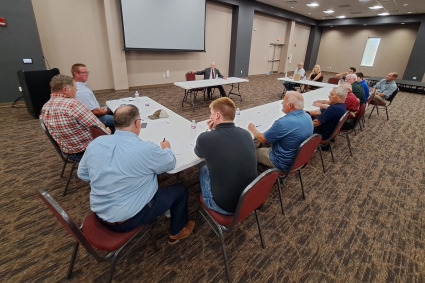
U.S. Sen. Charles Grassley spent an hour in Malvern last week discussing a variety of agriculture-related issues with local Farm Bureau members.
The round table discussion took place at the Charles E. and Florence M. Lakin Community Center.
One topic of discussion was the Supreme Court’s decision in May regarding WOTUS (Waters Of The United States).
In its ruling, the Supreme Court overturned the Environmental Protection Agency’s definition of wetlands that fall under the federal agency’s jurisdiction and eliminated the requirement for private property owners to obtain a federal permit to build on land that lacked navigable water.
The ruling is regarded as a significant change to the way wetlands are regulated under the Clean Water Act, established in 1972.
“It’s a very, very big win,” Grassley said of the Supreme Court decision. “Not only for WOTUS, but in respect to the federal government regulating private property that you get your income from.”
A member of the round table brought up concerns about foreign acquisition of farmland in the U.S. Grassley said he supports the work fellow Iowa Sen. Joni Ernst is doing in an attempt to overhaul current policies and limit China’s ability to purchase farmland in the U.S. and in some cases strip existing foreign land owners of their real estate.
The bipartisan proposal from Ernst, a Republican, and Michigan Democratic Sen. Debbie Stabenow, was announced in June.
“I would agree with what she (Ernst) is trying to do,” Grassley said. “She’s doing some things beyond that and there’s nothing wrong with what she’s doing.”
In a joint statement released last month, Ernst and Stabenow said they’re “taking the action as a response to reports of China threatening America’s food supply and posing an even greater national security risk by acquiring U.S. farmland near military bases.”
Some other topics of disucssion included bio-fuels, fertilizer prices, trade agreements and the potential impact clean energy iniatives could have on agriculture in the future.